The Isonda Gold Project sits on the same folded-BIF architecture that hosts Geita and Nyanzaga. We're funding the surface mapping, sampling and geophysics SRK Exploration needs to de-risk the Rank 1 zones before any drilling decision.
Fire assay results from selective rock-chip sampling, verified against SGS Mwanza lab certificates, returned 14 samples above 1 g/t Au. The five highest are logged here.
SRK Exploration mapped nine main shear zones and ranked each by combined shearing intensity, alteration, arsenic response and radiometric signature.
Strongest combination of shearing, hematite/limonite and sericite/kaolinite alteration, elevated arsenic, and high-intensity radiometric potassic response.
High-intensity potassic response and elevated soil arsenic, within the same structural corridor as the Rank 1 zones.
No clear radiometric association yet — flagged for revisiting once the Rank 1 and 2 zones are better constrained.
Within mineralised shears, gold shows a strong positive correlation with arsenic, cadmium and yttrium. Gridded soil surveys show silver anomalies coincide with the same structures.
Libra Geophysics' Dipole-Dipole IP survey independently mapped five targets, T1 through T5, folded and widening at fault intersections below 20 m depth. T4 sits closest to the artisanal workings that returned the rock-chip grades above. SRK's independent review found the case for drilling any of them premature ahead of surface confirmation — the phase-one programme is what determines which, if any, get drilled.
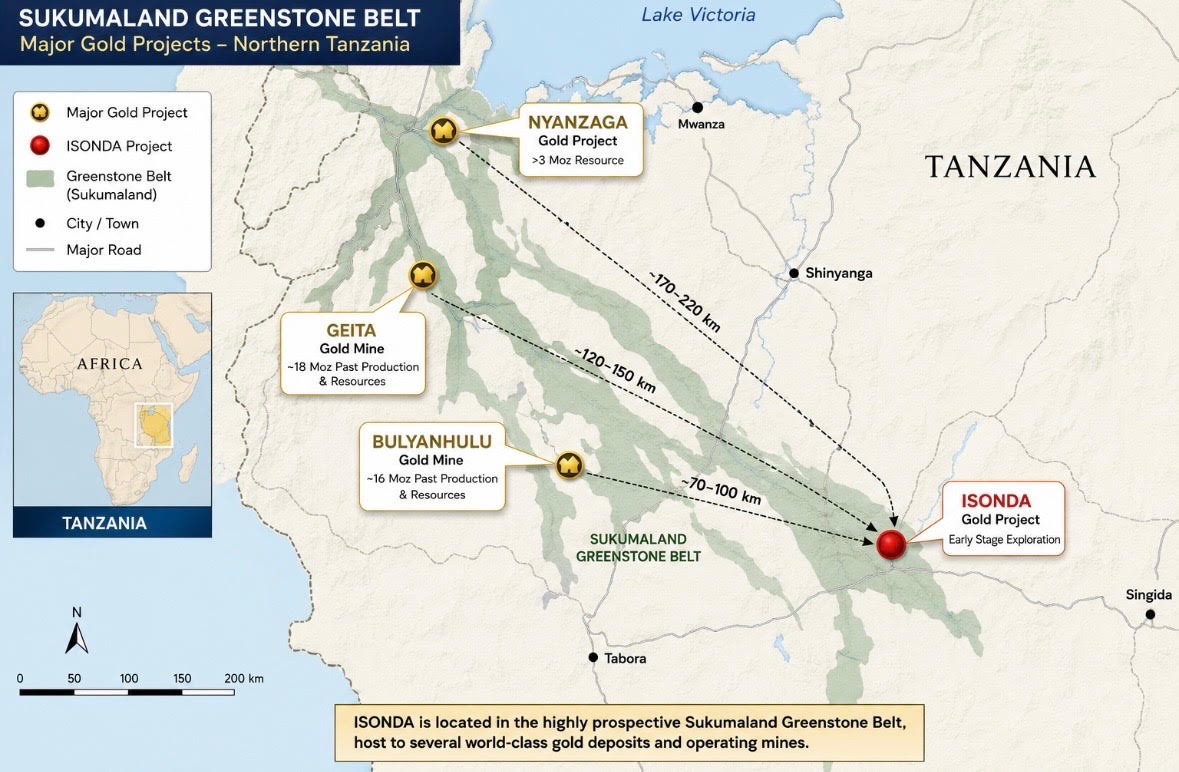
Isonda sits in the outer arc of the Sukumaland Greenstone Belt, the same belt hosting Geita, Bulyanhulu and Nyanzaga.
Prospecting Licence PL 11679/2021, Nyangw'ale District, Geita Region — granted 20 Aug 2021, current to 19 Aug 2028.
Isonda sits within the highly structural outer arc of the Sukumaland Greenstone Belt. The bedrock framework is dominated by interlayered Banded Iron Formation, chemical chert ridges, and volcaniclastic tuffs, cut by northwest–southeast regional ductile shear zones.
SRK Exploration's technical review classifies regional Sukumaland gold deposits into two structural families: folded BIF units — the style at Geita and Nyanzaga, and Isonda's own host rock — and quartz veins within shear zones, the style at Bulyanhulu. SRK considers Isonda's deposit model robust enough to justify a focused, staged exploration programme, while noting the project remains greenfield stage with no guarantee of an economic discovery.
Banded Iron Formation — the dominant host lithology, iron-oxide banding interlayered with chert.
Volcaniclastic tuffs bound the sequence, marking the outer-arc volcanic contribution.
Regional NW–SE ductile shear zones provided the fluid pathways that concentrated gold at structural intersections.
SRK Exploration's own review calls immediate drilling premature. Capital raised funds the surface programme that has to happen first — the sequence below, run end to end by SRK.
Hand/mechanical stripping over Rank 1 and 2 zones to expose the full shear corridor, with detailed lithological and structural mapping.
Systematic channel sampling across every exposed shear, fire-assayed at an accredited lab, with pXRF arsenic screening in the field.
High-resolution radiometric and magnetic survey over the Rank 1/2 corridor to refine shear positions ahead of any drill planning.
Oriented diamond drilling of confirmed ore shoots — contingent on positive surface results — as the basis for any future resource estimate.
To systematically identify, delineate, and de-risk high-potential precious metals assets within Africa's premier greenstone belts — through rigorous geoscientific methodology and institutional-grade engineering partnerships.
Reach out and a member of the Isonda team will follow up with the details relevant to your interest.